
Learning from Lauricocha
Author: Alisa Bollich
Howdy! My name is Alisa Bollich, and I am a junior archaeology student at Texas A&M University. This summer I had the absolute privilege of being a part of a Paleo Andes excavation for the first time in the Peruvian highlands.
When I originally set out to write this blog about halfway through the field season, I was still reeling from the most intense culture shock I had ever experienced. There is no place in the world more intense, beautiful, and overwhelmingly chaotic like Peru. In perfect honesty I didn’t really believe culture shock was a real phenomenon until this past month when I took on the challenge of throwing myself into this incredible culture. The journey from Lima to Lauricocha introduced me to lomo saltado and chaufa, cafe con crema, markets, mototaxis, Quechua and so much more.

After arriving in Laruricocha the initial shock settled and I began the routine of excavation, dishes, and card games after dinner. We met our team dog Osita (Little Bear), who adopted us as her new herd to guard and guide, so naturally we give her bread every day as payment for her hard work and dedication. Although Kurt fears she has begun to slip into bread madness, we give in anyway.

In reflection, I don’t think I’ve done anything as hard as this in my whole life, living so far from the comforts of home and in such an unfamiliar world. This journey has managed to tax my mind, body and spirit like no other, and I would be lying if I said I didn’t have my doubts about being here. But those thoughts don’t have time to linger because every time I look at the artifacts we found or at the snow capped mountains, I get so wonderfully and gently humbled. I think about how few people in the world get to experience what is at my fingertips right now, and I remember how hard I worked to get where I am and how far I have to go.
The excavation itself has been challenging like no other. For two weeks the team hacked away at back fill, two meters deep into the earth in a desperate attempt to find the original profile walls of Cardich’s original excavation in the 1950s. Despite the challenge, we managed to uncover not one but two beautiful bone flutes, and at least two small ceramic llama statues. Several spindle weights and many lithic scrapers, bifaces, and points have all been recovered as well.
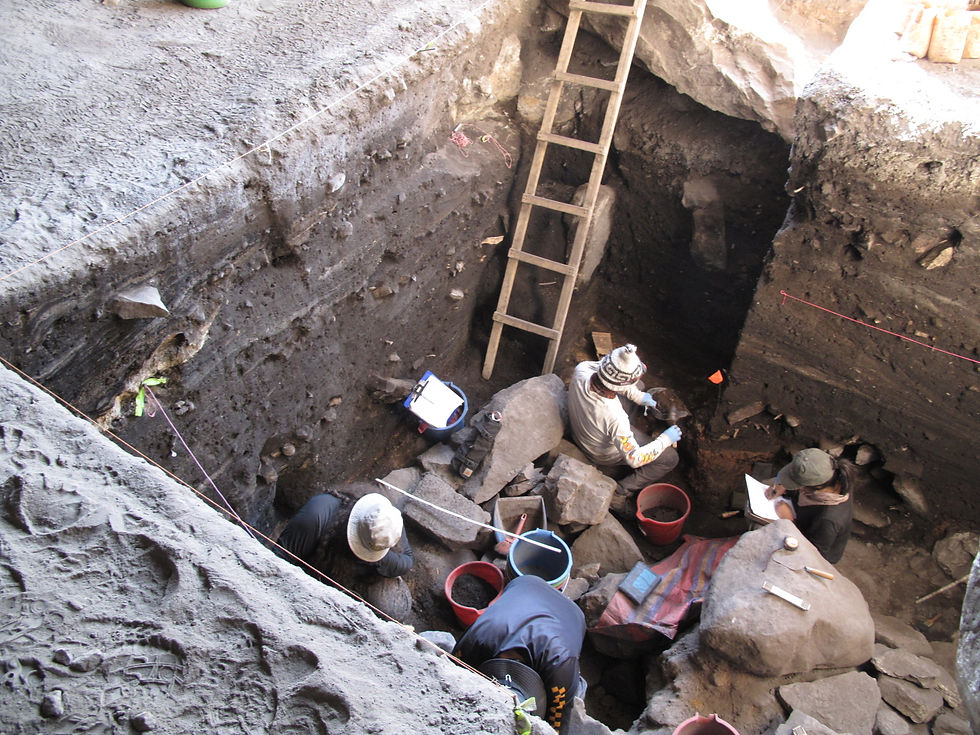
By the beginning of week three, we finally earned what we worked so hard for - four beautifully stratified walls and two new excavation units filled with surprises. Day by day, we took 5 centimeters away, level by level, until we got to the bottom. The initial eight layers of Unit 2 represented the modern and ceramic period, which were relatively uneventful as expected. What waited below was another 30 levels of hearths, lithics, macrobotanical remains, animal bones, and burials. We knew to expect several incomplete human burials from the reports that Cardich left behind, but the closer we got to the base, the more appeared. In some cases we found ocher, beads, lithics, and even stone clusters. But in one very special case, I happened to come across the find of a lifetime.

I was excavating level 28 in Unit 2 with Paolo Gutierrez when I came across what I originally thought was bone due to the red-orange color peeking through the surface. Once I started pulling away soil from that area, I noticed that it was in fact a small oval stone that was crafted because of how smooth it was. This rock was so smooth, I knew instantly it was undoubtedly a craft made by humans. I picked it up telling my excavation partner excitedly that I thought I found a large stone bead, but when Paolo looked at it, he practically screamed “Figurina!! Es una figurina!!” I began jumping in pure excitement yelling at Kurt to come over as fast as possible. Once we all agreed that it was in fact some kind of figurine, my body buzzed with unnatural levels of joy and excitement, and my partner was even crying at the beauty and rarity of the find. Countless photos and conversations followed, and that day went down as one of the very best of my life.


Ironically, I had a discussion with Kurt just a few days prior that I realized my true passion in the field was mortuary archeology - the cultural environment and circumstances around all human burials. So to find such a rare and gorgeous piece of history forgotten under meters of soil for thousands of years, in a burial context as most likely an offering of some kind, was some kind of unique and divine sign that I really am in the right place at the right time, and that my interests could be the start of a great career.
Later that week, I kept uncovering burial after burial in some intensely complex circumstances and contexts. Because of being in this remote, yet beautiful place, all of my favorite things in the world seemed to meld together. From my work in the excavation, to hiking in the puna to survey caves, exploring the interior of caves, swimming in cold lakes, and even seeing the Milky Way every night was truly a dream come true. This was an experience of a lifetime, and it just makes me all the more excited to see what the future has in store for me.


Comments